
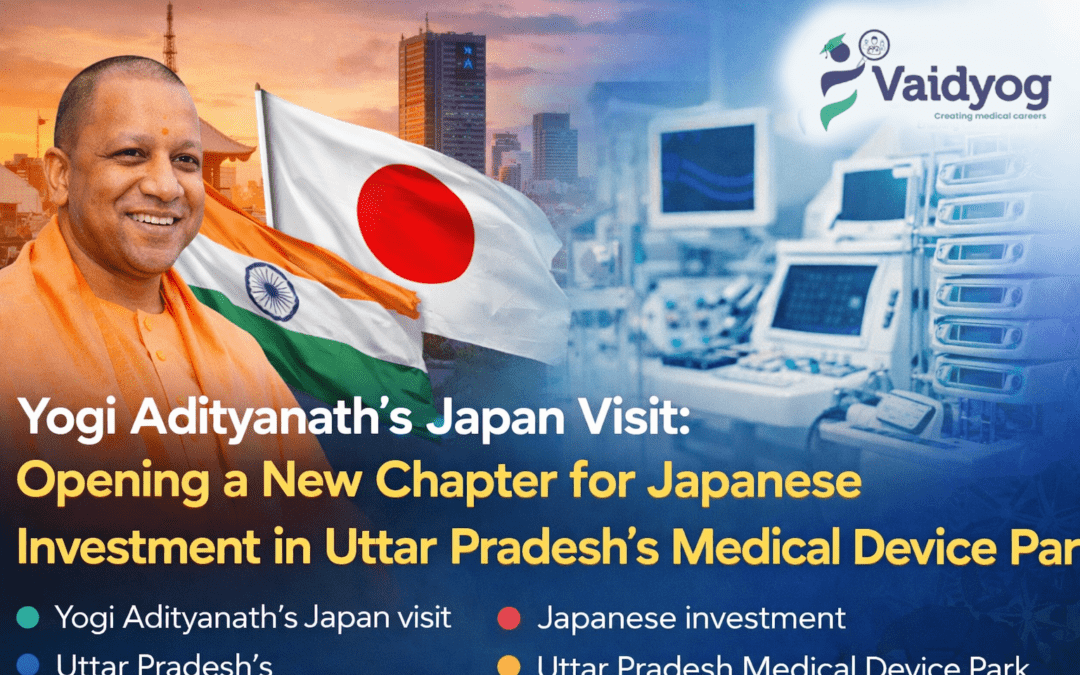
Tokyo, February 25‑26, 2026 – In a high‑profile two‑day visit that underscores Uttar Pradesh’s ambition to become the next manufacturing hub for Asia, Chief Minister Yogi Adityanath met with top executives of leading Japanese firms in Tokyo. The chief aim: to pitch the state’s forthcoming YEIDA Medical Device Park as a “golden opportunity” for Japanese investors and to showcase the broader investment ecosystem that the state now offers in logistics, warehousing, and multi‑modal transport infrastructure.
The itinerary, packed with back‑to‑back meetings with CEOs of Konoike Transport, Mitsui & Co., and senior officials from a dozen other Japanese corporations, marks a decisive shift in the state’s outreach strategy. It signals that Uttar Pradesh is no longer content to be a passive recipient of domestic capital; it is actively courting world‑class technology, capital, and management expertise from Japan—a country renowned for precision engineering, cutting‑edge medical technology, and a robust manufacturing culture.
1. Uttar Pradesh on the Rise: From Agricultural Heartland to Industrial Powerhouse
Over the past five years, Uttar Pradesh (UP) has quietly transformed itself into one of India’s fastest‑growing economies. With a Gross State Domestic Product (GSDP) that crossed $300 billion in FY 2025, the state now accounts for roughly 9 % of India’s total GDP. Several factors have contributed to this surge:
| Factor | Description |
|---|---|
| Strategic Location | Situated in the heart of the Indo‑Gangetic plain, UP enjoys proximity to the Delhi‑National Capital Region (NCR), the country’s largest consumer market, and easy access to major highways, railways, and airports. |
| Infrastructure Push | Massive investments in expressways (Yamuna Expressway, Ganga Expressway), freight corridors (Eastern Dedicated Freight Corridor), and airport upgrades (Lucknow, Varanasi, Kanpur) have dramatically improved connectivity. |
| Policy Reforms | The introduction of a single‑window clearance system, a transparent land‑bank portal, and a string of fiscal incentives (including tax holidays for manufacturing units) have cut bureaucratic red tape. |
| Skilled Workforce | A pool of over 15 million employable workers, supported by a network of ITIs, engineering colleges, and vocational training centres, provides the human capital needed for high‑value manufacturing. |
| PLI Schemes | The Union Government’s Production‑Linked Incentive (PLI) programmes for sectors such as medical devices, pharmaceuticals, and logistics have attracted both domestic and foreign investors. |
Chief Minister Adityanath has repeatedly emphasized that “Uttar Pradesh is not just a land of agriculture; it is a land of opportunity for industry.” The Japan visit is a concrete embodiment of this vision.
2. The YEIDA Medical Device Park: A Magnet for High‑Tech Manufacturing
At the heart of the Chief Minister’s pitch is the Medical Device Park being developed by the Yamuna Expressway Industrial Development Authority (YEIDA). The park, slated to cover several hundred acres along the Yamuna Expressway, is envisioned as a comprehensive ecosystem that brings together component suppliers, research institutions, testing laboratories, and manufacturing units under one roof.
2.1 Why the YEIDA Region?
- Strategic Connectivity: The park sits just 60 km from Delhi, directly linked to the Yamuna Expressway that connects the capital to Agra and further to the upcoming Delhi‑Mumbai Industrial Corridor (DMIC). This gives investors a seamless link to the Delhi‑NCR market, India’s largest consumer base, and to export gateways such as Jawaharlal Nehru Port (Mumbai) and Hazira (Gujarat).
- Existing Industrial Fabric: The YEIDA zone already hosts a growing number of auto‑components, electronics, and logistics firms, creating a synergistic environment for medical device manufacturers.
- Planned Infrastructure: The park will offer purpose‑built roads, reliable power (including dedicated 24/7 supply), water & effluent treatment plants, and modern warehousing. A dedicated “Medical Device Testing & Certification Centre” is also on the drawing board, a crucial factor for companies seeking quick regulatory approvals.
- Policy Incentives: The state government has announced a package of fiscal benefits—100 % exemption from stamp duty for land purchases, 5 % interest subsidy on loans for plant & machinery, and reimbursement of Goods & Services Tax (GST) for a period of five years. The PLI scheme for medical devices adds a further 5‑10 % incentive on incremental sales.
2.2 The “Golden Opportunity” for Japanese Companies
Japan is a world leader in medical technology—its companies dominate global markets for imaging systems (MRI, CT scanners), surgical robotics, diagnostic kits, and high‑precision consumables. Yet, many Japanese firms have yet to fully tap the Indian market, which is projected to reach $50 billion by 2025 and $80 billion by 2030.
The YEIDA Medical Device Park addresses this gap by offering:
- Cost‑Competitive Manufacturing: Land and labour costs in Uttar Pradesh are significantly lower than in Japan or even in tier‑1 Indian cities, enabling price competitiveness.
- Access to a Huge Consumer Base: With a population of over 1.4 billion, India’s expanding middle class and universal healthcare initiatives (Ayushman Bharat) drive demand for affordable, high‑quality medical devices.
- Export Hub Potential: The park’s proximity to the Delhi‑Mumbai freight corridor and upcoming Western Dedicated Freight Corridor makes it an attractive base for exporting to Southeast Asia, the Middle East, and Africa.
- Technology Transfer & Co‑development: Partnerships with Indian research institutes (e.g., IIT‑BHU, AIIMS) can foster joint R&D, allowing Japanese firms to co‑create products tailored for emerging markets.
3. Japanese Investment Landscape: Why Now?
3.1 The “China Plus One” Trend
Japanese corporations have been actively diversifying their manufacturing footprint beyond China, seeking alternatives that combine lower risk, stable politics, and robust supply chains. India, with its large domestic market, rising manufacturing capabilities, and favorable government policies, has emerged as a top contender.
3.2 Government‑to‑Government Synergy
The India‑Japan partnership is anchored by the India‑Japan Economic Partnership Agreement (IJPEA) and the India‑Japan Industrial Competitiveness Initiative (IJICI). Both governments have identified medical devices and logistics as priority sectors, creating a supportive bilateral environment for joint ventures.
3.3 Success Stories
- Terumo, a Japanese medical device giant, already runs a manufacturing unit in SriCity (Andhra Pradesh) and is exploring a second facility in Uttar Pradesh.
- Olympus has a diagnostics equipment plant in Chennai, and several other Japanese firms have set up R&D centres in Bangalore and Hyderabad. Uttar Pradesh now aims to attract similar ventures.
4. Key Meetings: Building Bridges with Japan’s Business Leaders
4.1 Shigeki Tanabe – Konoike Transport
Chief Minister Adityanath’s first meeting was with Shigeki Tanabe, Business In‑Charge of Konoike Transport, one of Japan’s largest logistics and warehousing companies. Their discussion centred on:
- Logistics Parks & Warehousing: Konoike expressed interest in developing state‑of‑the‑art multimodal logistics hubs across Uttar Pradesh, leveraging the Yamuna Expressway and the upcoming Eastern Freight Corridor.
- Cold‑Chain Solutions: With medical devices often requiring temperature‑controlled supply chains, a partnership could bring Japan’s renowned cold‑chain technology to India’s interior.
- Last‑Mile Connectivity: The CEO highlighted the potential for integrating Japanese‑made electric delivery vans and automated sorting systems into Uttar Pradesh’s burgeoning e‑commerce ecosystem.
Adityanath assured Tanabe of a “single‑window” facilitation, emphasizing that the state will provide ready‑to‑use industrial plots, expedited approvals, and a dedicated liaison officer for each project.
4.2 Kazuki Shimizu – Mitsui & Co.
The second high‑profile meeting was with Kazuki Shimizu, Managing Officer and Chief Operating Officer of the Infrastructure Projects Business Unit at Mitsui & Co., a global conglomerate with a strong foothold in infrastructure development. The discussion covered:
- Multi‑Modal Transport Infrastructure: Mitsui is keen to explore public‑private partnership (PPP) models for building intermodal terminals that link road, rail, and inland waterways in the state.
- Medical Device Park Development: Mitsui expressed interest in co‑investing in the YEIDA Medical Device Park, potentially bringing in Japanese construction firms and technology providers.
- Sustainable Infrastructure: Both parties discussed the integration of green building standards, renewable energy (solar rooftops), and waste‑water recycling within the park, aligning with Japan’s expertise in eco‑friendly manufacturing.
The Chief Minister highlighted Uttar Pradesh’s commitment to “swift decision‑making” and promised a “predictable regulatory environment” — a key selling point for risk‑averse Japanese investors.
5. Policy Stability & Ease of Doing Business: The UP Advantage
One of the strongest selling points articulated by Yogi Adityanath during his Tokyo roadshow is the policy stability that his government offers. Over the past seven years, the UP administration has:
- Streamlined Approvals: The Uttar Pradesh Investment Promotion Portal provides online clearances for land, environment, power, and labour within 30 days.
- Land Bank: The state has curated a digital land bank of over 1.5 million acres ready for industrial use, eliminating the time‑consuming process of land acquisition.
- Skilled Workforce: A dedicated Skill Development Mission has trained more than 2 million youth in industry‑relevant trades, with special modules for medical device assembly and quality control.
- Fiscal Incentives: Beyond the PLI, the state offers capital subsidies, interest rebates, and tax refunds for large‑scale manufacturing units, especially in high‑tech sectors.
- Single‑Window Clearance: The Uttar Pradesh State Industrial Development Authority (UPSIDA) acts as a one‑stop shop, coordinating with 30+ departments to ensure seamless project roll‑out.
These measures have helped Uttar Pradesh climb the Ease of Doing Business rankings in India, moving from 14th place in 2020 to 7th in 2025—a trajectory that Japanese investors find increasingly attractive.
6. Potential Impact: What Japanese Investment Could Mean for Uttar Pradesh
6.1 Job Creation & Skilling
- Direct Employment: A fully operational medical device park could generate 30,000–50,000 direct jobs, ranging from assembly line workers to biomedical engineers.
- Indirect Employment: Ancillary industries—logistics, packaging, component manufacturing—are expected to create an additional 80,000–100,000 positions.
- Skill Upgradation: Partnerships with Japanese training institutes could set up centres of excellence in medical device technology, ensuring a pipeline of skilled talent.
6.2 Technology Transfer & Innovation
Japanese firms bring precision engineering, advanced robotics, and strict quality standards (ISO 13485, JIS Q 9100). By establishing R&D centres in the park, they can adapt their technologies for the Indian market, leading to affordable, high‑quality devices that can also be exported.
6.3 Healthcare Outcomes
A robust domestic manufacturing base for medical devices will:
- Reduce Import Dependence: India currently imports over 70 % of its medical equipment. Local production will cut the trade deficit and improve supply chain resilience.
- Lower Costs: “Made in India” devices can be priced 20‑30 % lower than imported equivalents, expanding access to hospitals and clinics under the Ayushman Bharat scheme.
- Boost Rural Healthcare: Affordable devices such as portable ultrasound machines, glucose monitors, and low‑cost ventilators can be deployed in remote Primary Health Centres (PHCs), improving primary care delivery.
6.4 Export Potential
With the Delhi‑Mumbai Industrial Corridor and upcoming Western Dedicated Freight Corridor, the YEIDA park can become a regional export hub for Southeast Asia, the Gulf, and Africa. Japanese firms, with their established export networks, can leverage this advantage to tap new markets.
7. Broader Implications for India‑Japan Relations
The visit is more than a business pitch; it is a diplomatic bridge. Japan has long been India’s most trusted economic partner in Asia, contributing over $30 billion
source : https://www.digitalhealthnews.com/yogi-adityanath-courts-japanese-investors-pitches-yeida-medical-device-park-in-tokyo


Vaidyog is India’s leading healthcare career and recruitment platform, built exclusively for medical and allied healthcare professionals. We connect doctors, nurses, paramedics, pharmacists, and healthcare institutions through verified job opportunities, career guidance, and industry-relevant insights.
Designed to bridge the gap between talent and opportunity, Vaidyog empowers healthcare professionals to discover the right roles faster while helping hospitals, clinics, and healthcare organizations hire trusted, qualified professionals with ease.
With a focus on innovation, transparency, and growth, Vaidyog is redefining how healthcare careers are built in India—making hiring smarter and career journeys stronger.