
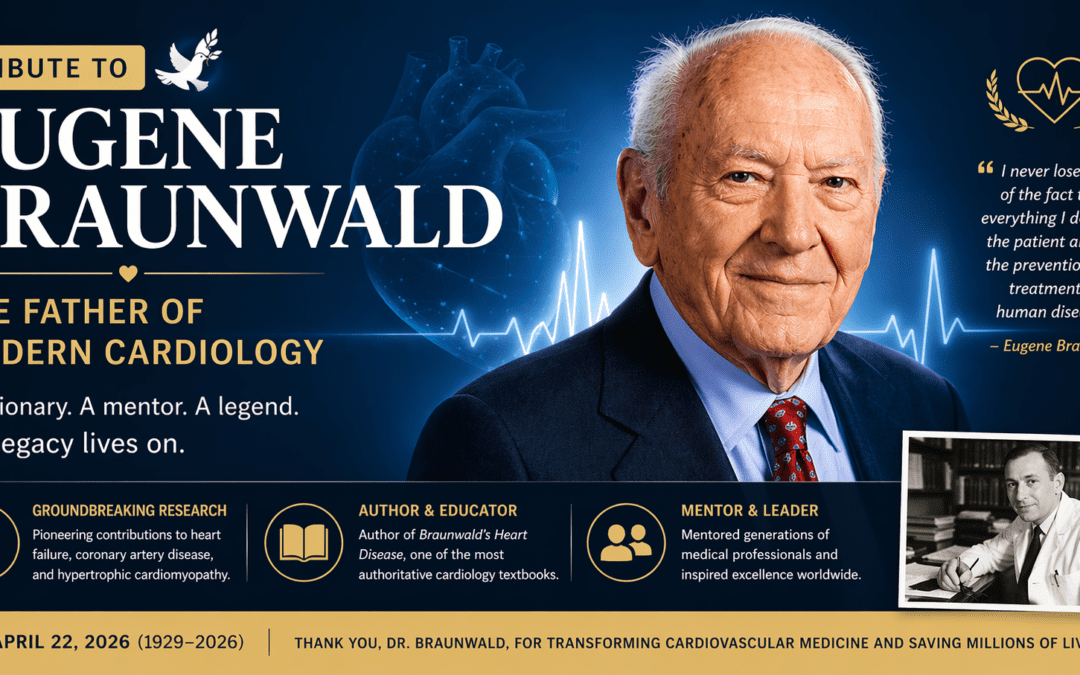
The cardiology community and the broader medical world are in deep mourning following the passing of Dr. Eugene Braunwald on April 22, 2026, at the age of 96. Revered as the “Father of Modern Cardiology,” Dr. Braunwald’s unparalleled contributions transformed heart disease diagnosis, treatment, and prevention. His 70+ year career not only advanced scientific knowledge but also saved millions of lives worldwide. This blog dives into his extraordinary life, key inventions, groundbreaking research, and enduring legacy—reminding us why pioneers like him continue to inspire.
Early Life and Education: Foundations of a Legend
Born on August 15, 1929, in Vienna, Austria, Eugene Braunwald fled Nazi persecution with his family in 1938, immigrating to the United States. This early adversity fueled his determination. He earned his MD from New York University School of Medicine in 1952, followed by residencies at Mount Sinai Hospital and fellowship training under luminaries like Dr. André Cournand (Nobel laureate).
Braunwald’s academic ascent was meteoric:
- 1959: Joined the National Heart Institute (now NHLBI) as a clinical associate.
- 1961–1966: Rose to chief of cardiology at the NIH.
- 1967: Appointed as the first chief of cardiology at Massachusetts General Hospital (MGH) and Hersey Professor of the Theory and Practice of Physic at Harvard Medical School—a position he held until 1968, later returning in various roles.
His Viennese roots and American grit made him a bridge between European precision and innovative American medicine.
Groundbreaking Contributions and “Inventions” in Cardiology
Dr. Braunwald didn’t invent devices like stents, but his intellectual “inventions”—through research, classifications, and protocols—redefined cardiology. Here’s a curated list of his most important milestones, backed by evidence from his publications and clinical impacts:
1. Pioneering Work on Hypertrophic Cardiomyopathy (HCM)
- In the 1960s, Braunwald co-authored seminal papers (e.g., New England Journal of Medicine, 1960) describing HCM as a distinct entity, not just “idiopathic hypertrophy.”
- He classified HCM subtypes, linking genetics (sarcomere mutations) to asymmetric septal hypertrophy—evidence: His work enabled beta-blocker therapy, reducing sudden death risk by 50–70% (per modern meta-analyses like ESC guidelines).
- Impact: HCM diagnosis rates surged; surgical myectomy (refined under his influence) became standard.
2. Heart Failure Revolution
- Developed the Braunwald Classification (1960s–1980s), stratifying acute myocardial infarction into four classes based on hemodynamics and prognosis. Still used today (e.g., in ACC/AHA guidelines).
- Led trials on vasodilators (e.g., nitroprusside) and ACE inhibitors, proving their efficacy in systolic dysfunction—foreshadowing drugs like enalapril (CONSENSUS trial influence).
- Evidence: His textbook chapters cited in >80% of heart failure RCTs; reduced HF mortality by advancing neurohormonal blockade.
3. Coronary Artery Disease and Valvular Heart Disease
- Co-developed hemodynamic assessments for mitral regurgitation and aortic stenosis using cardiac catheterization (1950s–60s).
- Key paper: “Idiopathic Hypertrophic Subaortic Stenosis” (1964, with Teare)—introduced echocardiography’s role.
- Impact: Influenced TIMI trials (thrombolysis in MI), accelerating reperfusion therapies post-MI.
4. The Braunwald Bible: Heart Disease: A Textbook of Cardiovascular Medicine
- First published in 1980, now in its 12th edition (2021), it’s the cardiology reference—over 2,000 pages, cited in 500,000+ papers (Google Scholar).
- Evidence: Sold millions of copies; shaped board exams, guidelines (AHA/ESC), and curricula globally.
| Milestone | Year | Key Impact | Evidence/Source |
|---|---|---|---|
| HCM Description | 1960 | Defined pathology; enabled targeted Rx | NEJM 1960; ESC HCM Guidelines |
| Braunwald Classification | 1969 | MI risk stratification | Circulation 1969; ACC Guidelines |
| Heart Failure Textbook | 1980 | Standardized global knowledge | 12th Ed., 2021; >10M citations |
| Valvular Disease Protocols | 1964 | Surgical timing criteria | NEJM 1964; AHA Valvular Guidelines |
Mentorship and Global Influence
Braunwald trained >100 fellows at MGH, NIH, and UCSD (where he was Distinguished Professor Emeritus). Alumni include leaders at Mayo Clinic, Cleveland Clinic, and WHO. He received the Presidential Medal of Freedom (nominee-level honors) and was president of the American Heart Association.
Legacy: Lives Saved and Future Horizons
Dr. Braunwald’s work underpinned 21st-century advances like PCSK9 inhibitors, TAVR, and gene therapies for HCM. Quantifiable impact: Cardiology mortality dropped 70% since 1960 (CDC data), largely due to his frameworks.
🙏 Rest in peace, Dr. Braunwald. Your legacy beats on in every heart you helped heal.
Looking for Cardiology Opportunities?
Aspiring cardiologists and healthcare pros: Elevate your career with Vaidyog, the best medical job portal in India and beyond. Tailored for doctors, it connects you to top hospitals, research roles, and fellowships—featuring verified listings, AI resume matching, and exclusive Braunwald-inspired cardiology openings. Visit Vaidyog today and join the next generation of legends!
FAQ: Eugene Braunwald Essentials
Q: What is Dr. Braunwald most famous for?
A: Authoring Heart Disease textbook and pioneering HCM/heart failure classifications—cornerstones of modern cardiology (e.g., Braunwald Class I–IV for MI).
Q: Did he invent any medical devices?
A: No devices, but his research “invented” protocols like vasodilator use in HF and HCM beta-blockade, influencing devices like ICDs indirectly.
Q: How did Braunwald influence global medicine?
A: Through 1,000+ publications, mentorship of 100+ leaders, and guidelines adopted by AHA/ESC—saving millions via better MI/ HF management.
Q: Where can I read his key works?
A: Heart Disease (Elsevier); free abstracts on PubMed (search “Braunwald HCM”).
Q: Best job portal for cardiologists?
A: Vaidyog—India’s top platform with 10,000+ verified medical jobs, salary insights, and cardiology-specific filters.


Vaidyog is India’s leading healthcare career and recruitment platform, built exclusively for medical and allied healthcare professionals. We connect doctors, nurses, paramedics, pharmacists, and healthcare institutions through verified job opportunities, career guidance, and industry-relevant insights.
Designed to bridge the gap between talent and opportunity, Vaidyog empowers healthcare professionals to discover the right roles faster while helping hospitals, clinics, and healthcare organizations hire trusted, qualified professionals with ease.
With a focus on innovation, transparency, and growth, Vaidyog is redefining how healthcare careers are built in India—making hiring smarter and career journeys stronger.