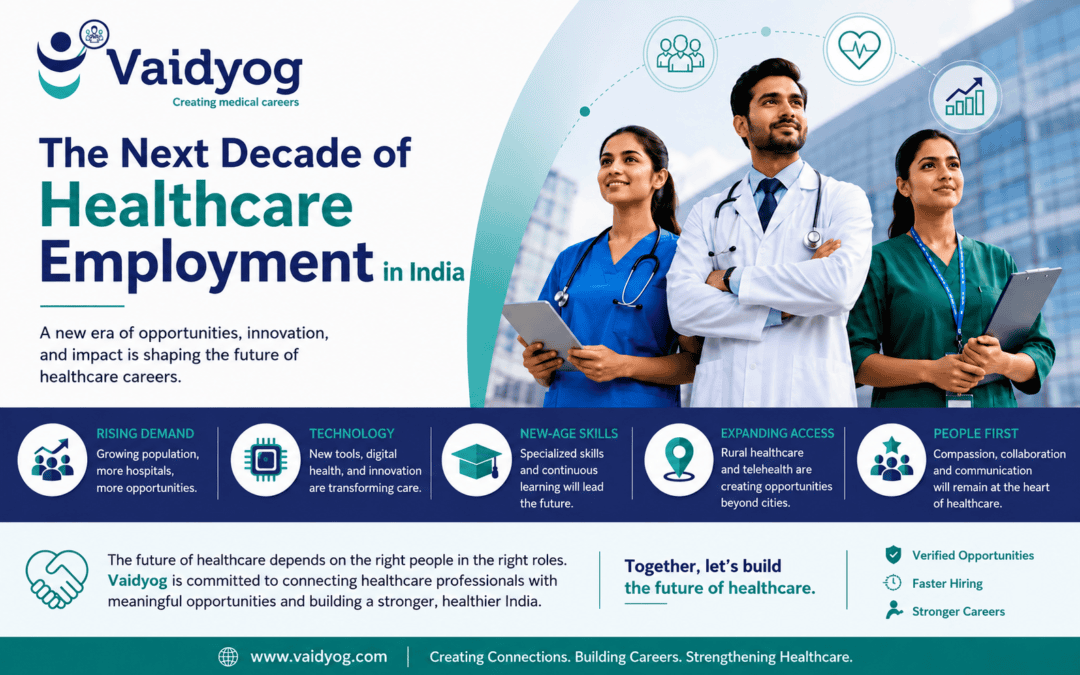
India’s healthcare sector is entering a defining era of transformation. Over the next decade, advancements in technology, growing healthcare awareness, expanding infrastructure, and increased government investment will reshape not only how healthcare is delivered but also how healthcare professionals build their careers.
The COVID-19 pandemic highlighted the importance of a resilient healthcare workforce and accelerated changes that were already underway. Today, hospitals are embracing digital solutions, patients are expecting more personalized care, and healthcare organizations are expanding into new specialties and regions.
According to industry estimates, India’s healthcare industry is expected to continue growing significantly, creating millions of employment opportunities across clinical, diagnostic, administrative, and technology-driven roles. This growth is not limited to metropolitan cities—Tier II, Tier III, and rural areas are also becoming important healthcare employment hubs.
For students, fresh graduates, and experienced healthcare professionals alike, the coming decade offers unprecedented opportunities. However, succeeding in this evolving landscape will require adaptability, continuous learning, and the willingness to embrace new technologies.
Let’s explore how healthcare careers in India are expected to evolve between 2026 and 2036.
The Indian Healthcare Industry Is Growing Faster Than Ever
Healthcare has become one of India’s fastest-growing sectors.
Several factors are contributing to this rapid expansion:
- Increasing life expectancy
- Rising burden of chronic diseases
- Growing middle-class population
- Expansion of private hospitals
- Government healthcare initiatives
- Health insurance penetration
- Digital healthcare adoption
- Medical tourism
- Investments in healthcare infrastructure
New multispecialty hospitals, diagnostic laboratories, specialty clinics, rehabilitation centers, home healthcare providers, and telemedicine platforms are being established across the country.
This growth naturally creates an increasing demand for qualified healthcare professionals.
Healthcare is no longer viewed as a traditional profession—it has become one of India’s most stable and future-ready career paths.
Healthcare Professionals Will Remain in High Demand
Doctors and nurses will always remain essential, but the healthcare ecosystem extends far beyond these professions.
Hospitals today require multidisciplinary teams working together to deliver safe, efficient, and patient-centered care.
Some of the healthcare roles expected to witness strong demand over the next decade include:
Clinical Professionals
- General Physicians
- Specialists
- Surgeons
- Dentists
- Nurses
- Nurse Practitioners
- Midwives
Allied Healthcare Professionals
- Laboratory Technicians
- Radiology Technologists
- Operation Theatre Technicians
- Dialysis Technicians
- ECG Technicians
- Anaesthesia Technicians
- Physiotherapists
- Occupational Therapists
- Speech Therapists
Diagnostic Professionals
- Medical Laboratory Scientists
- Pathology Technicians
- Imaging Specialists
- Sonographers
Pharmacy Professionals
- Pharmacists
- Clinical Pharmacists
- Pharmaceutical Consultants
Healthcare Management Professionals
- Hospital Administrators
- Healthcare Managers
- Quality Managers
- NABH Coordinators
- Medical Record Officers
Digital Healthcare Professionals
- Medical Coders
- Medical Scribes
- Clinical Data Specialists
- Health Information Managers
- Telemedicine Coordinators
The future healthcare workforce will be diverse, specialized, and collaborative.
Technology Is Reshaping Healthcare Careers
Technology is transforming healthcare faster than ever before.
Hospitals are increasingly adopting:
- Electronic Health Records (EHR)
- Artificial Intelligence
- Clinical Decision Support Systems
- Robotic Surgery
- Digital Imaging
- Telemedicine
- Wearable Health Devices
- Remote Patient Monitoring
- Automation in Diagnostics
Many professionals fear that automation may replace healthcare jobs.
In reality, technology is augmenting healthcare professionals rather than replacing them.
AI can analyze medical images faster, but radiologists still interpret findings.
Automation can process patient records, but healthcare administrators continue making strategic decisions.
Telemedicine expands access to care, but doctors remain responsible for diagnosis and treatment.
The future belongs to healthcare professionals who combine clinical expertise with digital competence.
Digital Skills Will Become Essential
Healthcare professionals are increasingly expected to work comfortably with technology.
Some of the most valuable digital skills include:
- Electronic Medical Record (EMR) management
- Telemedicine consultations
- Healthcare information systems
- Medical documentation
- Digital patient communication
- Clinical software platforms
- Healthcare analytics
- Data privacy and cybersecurity awareness
Professionals who continuously improve these skills will enjoy greater career opportunities and faster career progression.
Specialization Will Drive Career Growth
Healthcare is becoming increasingly specialized.
Hospitals are seeking professionals with expertise in focused areas such as:
- Critical Care
- Oncology
- Cardiology
- Neurology
- Nephrology
- Emergency Medicine
- Infection Control
- Intensive Care Units (ICU)
- Medical Imaging
- Hospital Quality
- Operation Theatre Management
- Organ Transplant Support
- Palliative Care
Specialized certifications often improve employability while opening doors to leadership positions.
Healthcare professionals who invest in advanced training will remain highly competitive throughout their careers.
Rural Healthcare Is Creating New Career Opportunities
Healthcare accessibility remains one of India’s biggest priorities.
Government initiatives, digital health missions, telemedicine services, mobile healthcare units, and public-private partnerships are expanding healthcare access to underserved communities.
This transformation is creating employment opportunities in:
- Community Health Centers
- Primary Healthcare Facilities
- Government Hospitals
- Mobile Medical Units
- Telemedicine Services
- Home Healthcare
- Public Health Programs
Working in rural healthcare offers professionals not only career growth but also the opportunity to create meaningful social impact.
Home Healthcare Is Emerging as a Major Employment Sector
Patients increasingly prefer receiving care in the comfort of their homes.
As a result, home healthcare services are expanding rapidly.
Professionals increasingly working in home healthcare include:
- Nurses
- Physiotherapists
- Elderly Care Specialists
- Palliative Care Experts
- Medical Equipment Specialists
- Home Diagnostic Professionals
This shift is expected to generate thousands of new employment opportunities over the next decade.
Soft Skills Are Becoming a Core Hiring Requirement
Clinical excellence alone is no longer enough.
Healthcare organizations increasingly prioritize professionals who possess strong interpersonal skills.
The most valuable soft skills include:
- Compassion
- Communication
- Emotional Intelligence
- Teamwork
- Leadership
- Adaptability
- Problem Solving
- Accountability
- Time Management
- Patient Counseling
These qualities improve patient satisfaction, reduce medical errors, and strengthen collaboration across healthcare teams.
Healthcare is fundamentally a human-centered profession, making empathy one of the most valuable professional skills.
Continuous Learning Will Define Long-Term Success
Healthcare evolves continuously.
New diseases emerge.
Treatment guidelines change.
Medical technologies improve.
Healthcare regulations evolve.
This means professionals must continuously update their knowledge.
Lifelong learning may include:
- Continuing Medical Education (CME)
- Professional Certifications
- Workshops
- Online Healthcare Courses
- Clinical Skill Training
- Hospital-Based Learning Programs
- Leadership Development
Those who embrace lifelong learning will be better prepared for leadership roles and future opportunities.
Healthcare Recruitment Is Becoming Smarter
Traditional healthcare hiring often involves lengthy recruitment cycles, manual resume screening, and limited access to verified candidates.
Modern recruitment platforms are transforming this process through digital innovation.
Hospitals increasingly expect recruitment platforms to help them:
- Access verified healthcare professionals
- Reduce hiring time
- Improve candidate quality
- Match skills accurately
- Simplify recruitment workflows
- Build long-term talent pipelines
- Support workforce planning through analytics
Healthcare professionals also benefit from digital hiring platforms by gaining easier access to verified job opportunities, transparent hiring processes, and faster communication with employers.
Digital recruitment is making healthcare hiring more efficient for everyone involved.
The Future Healthcare Workforce Will Be More Collaborative
Healthcare delivery increasingly depends on multidisciplinary collaboration.
Doctors, nurses, pharmacists, laboratory professionals, therapists, administrators, technicians, and digital health specialists must work together to improve patient outcomes.
Successful healthcare organizations encourage:
- Cross-functional teamwork
- Collaborative decision-making
- Shared patient responsibility
- Technology-enabled communication
- Continuous professional development
Future healthcare leaders will be those who can collaborate effectively across diverse teams.
Career Advice for Healthcare Students and Professionals
If you’re planning a long-term healthcare career, consider these strategies:
- Build a strong clinical foundation.
- Learn digital healthcare tools and technologies.
- Develop communication and leadership skills.
- Pursue specialized certifications.
- Stay updated with medical advancements.
- Gain practical clinical experience.
- Build a professional network.
- Remain adaptable to change.
- Invest in continuous learning.
- Use trusted healthcare recruitment platforms to explore new opportunities.
Healthcare offers not just stable employment but also meaningful work that positively impacts lives every day.
Frequently Asked Questions (FAQs)
1. Which healthcare careers will be most in demand over the next decade?
Roles such as nurses, laboratory technicians, radiology technologists, pharmacists, physiotherapists, medical coders, healthcare administrators, emergency care specialists, and digital health professionals are expected to experience strong demand.
2. Will AI replace healthcare professionals?
No. AI is designed to support healthcare professionals by improving efficiency, diagnostics, and administrative processes. Human expertise, empathy, and clinical judgment remain essential.
3. Are healthcare careers future-proof?
Healthcare is considered one of the most resilient industries due to continuous demand for medical services, an aging population, technological advancements, and ongoing investments in healthcare infrastructure.
4. Why are digital skills becoming important in healthcare?
Modern hospitals increasingly rely on electronic medical records, telemedicine, healthcare software, digital diagnostics, and data-driven decision-making. Professionals with digital skills are better equipped to adapt to evolving healthcare environments.
5. What skills should healthcare professionals develop for long-term career growth?
Along with clinical expertise, professionals should focus on communication, teamwork, leadership, adaptability, digital literacy, problem-solving, and continuous learning.