Healthcare has always been a profession built on knowledge, compassion, and hands-on experience. Clinical expertise remains the foundation of quality patient care, but today’s healthcare job market demands much more than technical proficiency.
As hospitals adopt advanced technologies, digital health solutions, artificial intelligence (AI), electronic health records (EHRs), and patient-centric care models, employers are looking for healthcare professionals who combine clinical excellence with adaptability, communication, digital literacy, and a commitment to continuous learning.
The healthcare landscape has evolved—and so have the expectations of employers. Whether you’re a doctor, nurse, pharmacist, physiotherapist, radiology technician, laboratory technologist, or healthcare administrator, standing out now requires a broader set of professional skills.
The Healthcare Industry Is Changing Faster Than Ever
India’s healthcare sector is expanding rapidly, driven by increasing healthcare investments, digital transformation, medical tourism, and a growing demand for quality healthcare services. Hospitals are embracing smart technologies and improving operational efficiency to deliver better patient outcomes.
This transformation has changed the way healthcare professionals work.
Modern healthcare organizations expect employees to:
- Work with advanced medical technology
- Collaborate across multidisciplinary teams
- Follow standardized clinical protocols
- Use hospital management software and EHR systems
- Deliver exceptional patient experiences
- Adapt to rapidly changing healthcare environments
Clinical knowledge remains essential, but employers increasingly seek professionals who can thrive in these dynamic workplaces.
Clinical Skills Open Doors—Professional Skills Build Careers
A medical degree or years of clinical experience can help secure an interview, but long-term career success depends on much more.
Today’s hospitals evaluate candidates based on both technical competence and workplace readiness.
Professionals who combine clinical expertise with strong interpersonal and digital skills are more likely to secure leadership opportunities, promotions, and specialized roles.
Skills That Set Healthcare Professionals Apart
1. Strong Communication Skills
Healthcare relies on effective communication.
Professionals must communicate clearly with:
- Patients
- Families
- Doctors
- Nurses
- Laboratory teams
- Pharmacists
- Administrative staff
Strong communication improves patient satisfaction, reduces medical errors, and strengthens teamwork.
2. Digital Literacy
Healthcare is becoming increasingly digital.
Employers now expect professionals to be comfortable using:
- Electronic Health Records (EHR)
- Hospital Information Systems (HIS)
- Telemedicine platforms
- Digital diagnostic tools
- AI-assisted healthcare technologies
- Medical imaging software
Professionals with digital skills can adapt more quickly to modern clinical environments.
3. Adaptability
Medical science evolves every day.
New treatment protocols, technologies, regulations, and patient expectations require professionals to embrace change.
Adaptable professionals remain valuable because they continuously improve their knowledge and adjust to evolving healthcare practices.
4. Teamwork and Collaboration
Patient care is never delivered by one individual.
Doctors, nurses, pharmacists, therapists, technicians, administrators, and support staff work together to achieve positive outcomes.
Hospitals actively seek professionals who:
- Respect multidisciplinary teams
- Share knowledge
- Support colleagues
- Coordinate patient care effectively
Collaboration improves both patient safety and operational efficiency.
5. Critical Thinking and Problem Solving
Healthcare professionals often make decisions under pressure.
Whether responding to emergencies, interpreting diagnostic reports, or managing patient complications, critical thinking is an essential skill.
Employers value professionals who remain calm, analyze situations quickly, and make informed decisions.
6. Emotional Intelligence and Empathy
Patients remember how they were treated—not just medically, but emotionally.
Empathy helps healthcare professionals:
- Build trust
- Reduce patient anxiety
- Improve patient satisfaction
- Deliver compassionate care
Hospitals increasingly recognize emotional intelligence as an important part of quality healthcare.
7. Leadership Potential
Leadership isn’t limited to senior doctors or hospital administrators.
Healthcare professionals at every level can demonstrate leadership by:
- Taking initiative
- Mentoring colleagues
- Managing responsibilities effectively
- Supporting organizational goals
- Promoting patient safety
Hospitals appreciate professionals who contribute beyond their assigned roles.
Continuous Learning Is the New Competitive Advantage
Healthcare knowledge never stands still.
Medical innovations, research findings, updated treatment guidelines, and new technologies require professionals to remain lifelong learners.
Professionals who invest in learning through:
- Certifications
- Workshops
- Conferences
- Online courses
- Specialized training
- Skill development programs
often enjoy better career progression and increased employability.
Continuous learning demonstrates commitment, ambition, and professional excellence.
Professionalism Matters More Than Ever
Technical skills may secure a position, but professionalism determines long-term success.
Healthcare employers value professionals who consistently demonstrate:
- Accountability
- Ethical decision-making
- Time management
- Reliability
- Integrity
- Respect for patients
- Confidentiality
- Positive attitude
- Commitment to quality care
These qualities contribute to stronger workplace cultures and better patient outcomes.
Why Employers Look Beyond Clinical Experience
Healthcare organizations invest significant resources in hiring and training professionals.
They seek candidates who can:
- Learn quickly
- Adapt to technology
- Improve patient experience
- Work efficiently
- Handle workplace challenges
- Support organizational growth
Hiring managers increasingly prefer candidates who bring both technical expertise and soft skills to the workplace.
Building a Future-Ready Healthcare Career
Healthcare professionals can strengthen their career prospects by:
- Updating certifications regularly
- Learning digital healthcare technologies
- Improving communication skills
- Building leadership capabilities
- Networking within the healthcare industry
- Participating in professional development programs
- Staying informed about medical advancements
- Creating a strong, professional resume
- Gaining experience across diverse healthcare settings
Career growth is no longer based solely on years of experience—it depends on continuous improvement.
The Future of Healthcare Jobs
India’s healthcare industry is expected to create thousands of new opportunities across hospitals, clinics, diagnostic centers, telemedicine providers, and healthcare startups.
Demand is increasing for:
- Doctors
- Nurses
- Pharmacists
- Physiotherapists
- Radiology Technologists
- Laboratory Professionals
- Operation Theatre Technicians
- Biomedical Engineers
- Hospital Administrators
- Allied Healthcare Professionals
The professionals who succeed will be those who combine:
- Clinical Excellence
- Technology Readiness
- Communication Skills
- Leadership
- Collaboration
- Adaptability
- Continuous Learning
- Patient-Centered Care
These qualities make healthcare professionals indispensable in an increasingly competitive job market.
Conclusion
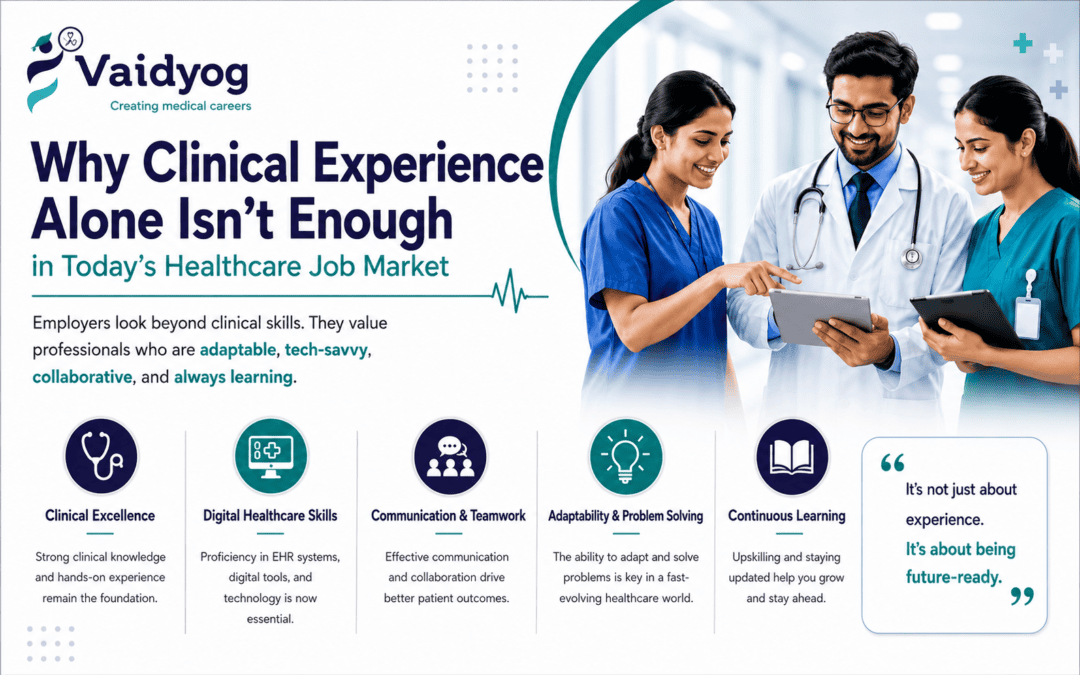
Clinical experience will always remain the foundation of a successful healthcare career—but in today’s competitive job market, it is no longer enough on its own. Employers are looking for professionals who combine clinical expertise with digital skills, adaptability, teamwork, communication, leadership, and a commitment to continuous learning.
Whether you’re searching for your first role or your next career opportunity, finding the right platform can make all the difference.
Vaidyog is India’s trusted healthcare recruitment platform, connecting verified healthcare professionals with leading hospitals, clinics, diagnostic centers, and healthcare organizations. From medical jobs, nursing jobs, and allied healthcare careers to hospital administration roles, Vaidyog helps job seekers discover verified opportunities that match their skills, experience, and career goals.
If you’re ready to advance your healthcare career and explore the latest medical jobs across India, Vaidyog is here to help you take the next step with confidence.
Frequently Asked Questions (FAQs)
1. Is clinical experience enough to get a healthcare job?
Clinical experience is essential, but employers also value communication skills, digital literacy, teamwork, adaptability, and continuous learning.
2. What additional skills do hospitals look for in healthcare professionals?
Hospitals prefer candidates with strong communication, problem-solving abilities, digital healthcare knowledge, leadership potential, professionalism, and the ability to work in multidisciplinary teams.
3. Why is digital literacy important in healthcare careers?
Modern hospitals use Electronic Health Records (EHR), Hospital Information Systems (HIS), telemedicine platforms, and digital diagnostic tools. Professionals who are comfortable with these technologies have a competitive advantage.
4. How can I improve my chances of getting hired in healthcare?
Keep your certifications updated, develop soft skills, learn new healthcare technologies, gain practical experience, build a professional resume, and apply through trusted healthcare recruitment platforms like Vaidyog.
5. What are the most in-demand medical jobs in India?
Some of the fastest-growing medical jobs include doctors, nurses, pharmacists, physiotherapists, radiology technicians, laboratory technologists, operation theatre technicians, biomedical engineers, hospital administrators, and allied healthcare professionals.